Managing Hypergamy

Hypergamy Chart

Hypergamy Chart

“We cannot manage that which we do not see…”


Unchanging Biological Nature

Often at opposition to the dramatic advances in feminist socialization, lies our biological nature which has not changed in millennia… at the heart of this is our limbic system, which supports a variety of emotional and behavioral functions, the most popular being, attraction, arousal and procreation drivers, otherwise known as one’s “Libido”. The importance of this is two-fold; the first is that this is a primitive, base need/driver and secondly that both men and women have it! Yes, women have not only a libido, but they ‘think’ with it similarly as males, although it does manifest itself differently amongst the sexes…

Hypergamy

Cultural Anthropologically speaking, this social biological expression for women has been termed Hypergamy or a woman’s hypergamous nature. It manifests itself in three distinct areas regarding sexual selection preferences;

Sexual dimorphism– the physical attraction triggers which tend to be size, strength, fitness and athletic prowess

Social dimorphism– behavioral traits associated with masculine alpha behaviors such as dominance, aggression, assertiveness, risk-taking, self-reliance etc…

Status dimorphism– these are your age-old markers of status projections of social standing, wealth, power and fame.

While our limbic system may be our base biological driver when it comes to sex drive, we needn’t be controlled by it, but if we are unaware of it, or how it plays out in our lives, we are very much at it’s mercy…. Hear that ladies??? That means YOU TOO!!! Just as a man can control his biological sexual nature to be monogamous, so to can a woman control her hypergamous nature of selecting douchebags and deadbeats, that trigger her hypergamous desires, but not her social desires of a compatible, loving and supporting mate.
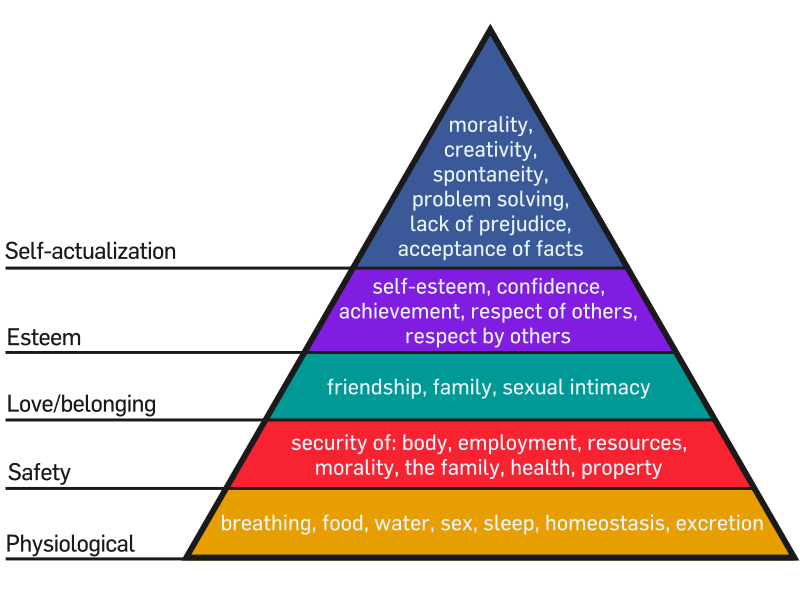
Maslow's Hierarchy of Needs

Hierarchy of needs

Maslow’s theory of Human Motivation clearly defines and categorizes base psychological needs in order of ascension. At its very base is the need psychologically for ‘sex’, even before ‘security’, and then ‘sexual intimacy’. What is important to realize about Maslow’s theory is that one cannot attain a higher state of psychological being without first fulfilling a lesser level… That being said those social levels associated with ‘Esteem’ and ‘Self-actualization’ cannot be fulfilled without the securing lower levels of being. Simply put attraction is not negotiable. As men, we have to first respond in answering and managing women’s hypergamous attraction triggers prior to developing any measure of relationship equity. Or as coined within the Men’s Community “Relationships are no sanctuary from Hypergamy”, “Hypergamy just doesn’t care!” or more encompassing “Hypergamy doesn’t care how long you’ve been dating/married, how faithful you’ve been, how decent, kind or supporting of a guy you are, how many children you have, what type of father you are to her children or what a ‘stellar male-feminist’ you are when faced to her biological drivers of sexual need and attraction.” These common Men’s Movement phrases underscore a very real and ugly reality at failing to meet and to maintain base biological attraction triggers of our relationship partners. Doubt it? Just dive into current divorce stats, who’s doing the filing and under what circumstances… Have a frank conversation with a divorce attorney or sit and listen to men destroyed by their failed marriages and our family court system. It is a very sobering experience to realize what it means for base biological and psychological needs to always trump higher social conventions… Ignore them is to do so at your own peril!

Manage yourself first…

All good leaders will lead from the front and by example. So too with really great managers, they will manage themselves before they attempt to manage others. Before as men we attempt to manage hypergamy with regards to women (telling women to control that shit), we need to address it ourselves by becoming they type of man women are naturally attracted to. That means achieving our natural potential of being fit, socially confident and professionally ambitious– to achieve and fulfill that social contract and male expectation of being a ‘protector and provider’… (Here’s a link to an organization that promotes all three and then some: The 21 Convention) Ladies, before you expect us to control our cocks and supplicate our natural biological prerogatives of promiscuity for monogamy, perhaps you should check yourselves first for your general levels of fitness, femininity and nurturing potential…

Survival of the fittest

It’s a jungle out there… it always has been. If you want to rise above it, you better start thinking, acting and planning like a Man (the species).


 

21 Convention Home Site

Relationship Management

Relationship manager


“Think ahead.  Don’t let day-to-day operations drive out  planning.”


The common nature of management…

We manage things all the time; our time, our energy, our resources, etc… some things need more attention that others and what gets our focus is a form of management. Managing issues through crisis or repeat crisis’s is a form of management, and so too is procrastination. While on the surface of it most of us would recognize that both of these are probably not the most appropriate or effective, but we all do it, even though we understand that there are other ways to seek out better results, in a more efficient and effective manner. People don’t need deep expertise and experience to understand the simple concepts and framework of management, when applied on a regular basis will produce dramatically superior results, we just need a general awareness of the principles and a consistent approach at implementing them over time, to develop behavior patterns that are in sync with those actions.

Simple things over and over again…

Management is boring. Really boring. It is about performing a series of tasks over and over again to gain a determined result, while maintaining and retaining staff. Boiled down to the simplest charge; good managers achieve results while retaining people… While this may sound very simplistic, because it is, it does not underscore the depth and breadth of complex issues, competing demands and hidden expectations surrounding any management function on any level, but it is what we ultimately are striving for…

It’s about people…

Business’s have increasingly recognized this for over a century now… as society has moved past the Industrial Age and well into the information and knowledge economy, businesses have become more and more cognizant of the importance of management and social skills are to the bottom line. While efficiency management, then project management were driving themes in management theory, successful business have recognized that good managers and leaders are the single most important group for determining whether an organization succeeds or fails… So too with relationships. The ability of partners to think and act like managers by developing a solid relationship with their partner, establishing clear and open lines of communication, appropriately leading by forming a consensus through collaboration building, being accountable for decision-making by seeking out and providing direct feedback to and for each other, while reducing fear, deepening trust and increasing respect have a much higher chance of achieving their relationship goals than do couples who do not. They will have a ‘business’ that runs more smoothly, are happier and more satisfying than those that fail to.

Management as craft…

Management is a craft. It take time to learn the basics, to develop real world experience and to foster the individual culture of self-development and improvement. You will make mistakes in judgment, errors of execution and negligence of action. There’s nothing wrong with making a mistake, but you make things worse by staying blind to your own errors without correction. It is hugely important to make daily mindful choices of actively practicing what we have learned and started to develop with others that surround your life. Strong competent managers are not simply born, they are developed; through hard work, careful analysis of their experiences and relentless self-education. It is a relationship craft that doesn’t get a lot of press or attention until they are missing… and when it is, benign negligence isn’t so benign.


Behind the Scenes with Socrates @ The 21 Convention -Austin

Behind the Scenes with Socrates @ The 21 Convention -Austin

Here’s a quick peek preview of the talk I gave at The 21 Convention-Austin. It’s short, clocking in at a little over 3 minutes, but gives a good insight into many of the points I covered in my talk and more importantly how that dove-tailed into the other talks given at the convention, as well as what I feel is the real value of attending an event centered around personal self-development and realization.

Each 21 Convention that I attend I’m more and more impressed with not only the quality of the speakers, the direction that the event is taking, but with the very real feedback coming from the attendees, at how these talks and the experience of attending has and is shaping and changing their lives. It’s just really an incredible reality to be a part of.

To find out more about this event:

 The 21 Convention

IMPULSE CONTROL & SELF-REGULATION

You cannot release tension by creating more of it…

Rationally, we know we cannot expect to live harmoniously with our partner at all times, but seldom do we emotionally accept that fact. Frustrations, unmet expectations, let downs, incivility, broached personal boundaries, poor behavior, brushes with insecurity issues, confrontations with un-resolved emotional developmental tasks can often trigger deep emotional reactions that fuel and give rise to unchecked jealousy and anger. These impulses drive our temptations to act utilizing rash behaviors and short-term decision-making that satisfy our basic instincts of self-preservation and immediate self-interest in releasing pent-up tension by lashing out. In the moment there is nothing more compelling and satisfying than completely releasing your engulfed rage and anger… …and then it is over… the moment and the relationship. You simply cannot have a healthy relationship where trust and respect do not exist, and in that moment of lost control and lack of self-regulation both were highly diminished if not destroyed. Just anger should be displayed in incredibly rare occasions and where it is truly warranted, if ever. Ultimately an angry defensive outburst moves you further, rather than closer together.

Negativity spiral of hostile reciprocation

It doesn’t have to be a flash of uncheck rage or anger that kills your relationship. The ease at which negativity, hostility and resentment builds into conflict, strife and reciprocated negativity is frightening, as it spins into an almost unrecoverable spiral of destructive behaviors, as partners interact in an absorbing state of animosity and hostility that fuels itself causing more harm to trust, respect and mutual admiration along the way… This negative spiral is one of the very real reasons that breaking up is the norm, not the exception in intimate relationships. We simply unwittingly fan the flames of demise without squelching them early when conflict is most manageable.

Pro-relationship action

An important function of promoting and enhancing your relationship is your ability to respond constructively rather than destructively to negative impulse temptations. To prevent damage to your relationship and to your reputation regard anger, frustration, the surge for dominance or aggressive competitive action to be ‘right’ or ‘win’ as a caution sign to alert your to problematic emotional situation. The angrier you feel, the less effective you will be able to solve any problem, as it decreases your ability to think, take in new information, take fresh perspective or to come up with new solutions. This is especially true in any form of group activity where consensus building or collaboration building is essential in pursuit of any shared or common goal.

Stop!

Taking a moment to take in a deep breath and letting the surge of adrenaline and emotions to pass through you, to clear your mind for an instant to think before you speak and to think twice before you act, may be all you need to release the tension and relax the body and mind from the fight or flight mode you’re currently on. It is this interruption that allows you to build awareness and establish self-control, to regulate yourself and to act through your beliefs appropriately. Taking a moment to stop and re-affirm your core values will ease the effects of hasty anger by reminding us why those values are important to us. By recognizing that anger is an emotional caution sign, it will help us focus on our long-term objectives, rather than short-term gratification and avoid our natural hazardous responses.

Look!

In the moment of pausing look into not only the situation, but what you really want. Take perspective. How you want to be regarded. Where you want the relationship to take you. How do you value the relationship. Who do you want to be. What are your values and are you acting through those. Focus on your behavior (the only thing you can control) and not of your partner’s is essential. Empowering yourself instead of attempting to control others or the situation is a key component of overcoming anger tendencies. Control what you can- you.

Listen!

Listen to your partner. Not just in what she is saying, not just in what she is doing, but listen for what may be driving those words and actions. Utilize your powers of perception to try to understand what are her needs, wants and feelings of expectations that are unresolved or unmet? What is she emotionally aching for that she cannot reach? Before we speak, before we act, be very careful not to invalidate your partner, as once we have the opportunity for any productive discussion or problem-solving is all but gone.

Listen deeper!

Listen deeper still. Listen to deep within yourself and ask yourself why you’re responding negatively rather than positively to a potentially destructive partner’s behavior? It most likely will underscore unresolved emotional or developmental tasks for yourself well beyond the initiating event. Mentally bookmark this emotional reaction response and investigate it by performing a psychological self-analysis by looking at emotional patterns of behavior, as well as perform a relationship autopsy of those relationships that surround those feelings. Frequently strong emotional responses are unconscious and subliminal signals that unresolved dependency needs and developmental tasks are unresolved and will hinder the health and wellbeing of not only your relationship, but for you as well.

Ego-depletion

Self-control is not the whole story in regulating impulse control. Stress, general frustration, exhaustion, poor nutrition, lack of sleep and competing simultaneous demands will affect will-power and self-control reserves of anyone. It is important to recognize that your self-regulatory strength may be limited. As it is depletable. As it is renewable. Even someone who is committed to his or her relationship may fail at self-regulating due to self-regulating strength depletion despite their motivation.

Self-monitoring

It is highly beneficial if we can self-monitor not only ourselves, but the circumstances and environment in which we are party to for signs that we may be taxed, fatigued or worn down and act to counter it. In many instances we can foresee and anticipate that in an up and coming situation we may reach a similar point, and instead of just ‘sucking it up and driving on’ we can actually pre-plan rejuvenating and energy replenishing actions strategically. Whether this is getting extra sleep and rest, eating properly, treating yourself well, taking a moment to pause and reflect, exercising, sharing a good meal with friends or having sex lavishly (even if it’s just with yourself) can all have a remarkable effect on your ability to express gratitude in life and confer an enormous happiness advantage in general.


The Power of Perception

“The eye sees only what the mind is prepared to comprehend”

Being socially competent in a relationship means recognizing that other people have emotions, desires, thoughts and beliefs, being able to properly interpret the other person’s inner state based on a multitude of observable behaviors that include body language, facial expressions, tonality, cadence of speech and word choices, while appropriately making behavioral decisions to nurture and support that relationship. The power of perception is a critical skill to develop for reading the wealth of information that is generated and communicated through body language within social interactions. This is incredibly true with intimate personal relationships, yet a common phenomena takes place; as we are exposed to greater and greater levels of shared information, personal narratives, thoughts, beliefs, dreams, fears and aspirations of our partner, we naturally tend to be less observant to the subtle social cues that we are highly vigilant of when we knew the person less. Countering this natural tendency, and actively being perceptive of our partners is an important relationship skill to develop, as it aids in communication and increases relationship bonding by validating your partner emotionally.

The power of emotional validation…

Women consistently state in social studies of being more satisfied in a relationship when their partner was attempting to be emotionally sensitive, demonstrate empathy skills, along with active listening traits to understand them and accurately judged their emotions (this is a form of preemptive emotional needs communication) . Consequently it is the second greatest factor in determining relationship longevity, the first being having an upbeat and positive attitude. (Depressed and negative partners are more than a drag, they are emotionally toxic and a direct threat to the health, wellbeing and effectiveness of the relationship. Militaries the world over recognize this and openly promote and manage morale welfare. It wouldn’t be foolish to develop a similar posture in our relationships.) What is of particular interest in these studies is that women also value the effort men make, almost as much as the outcome of the conversation. Women essentially value the emotional support given to them by their partner over any other base trait other than raw sexual attraction and security. By actively taking a leadership role and consciously monitoring our partners, being sensitive to their emotional shifts, employing active listening skills and providing simple emotional validation of our partners on a regular basis can we hugely affect the health and wellbeing of our relationships for the positive.

Poker face…

In poker, a “tell’ is a detectable change in a player’s behavior or demeanor that gives clues to that player’s assessment of their given hand. More accurately it is a change in a person’s behavior that gives clues to their emotional state or awareness. We all have them as we all have detectable changes in behavior based on our state of mind and the situation around us. This will be true of our partners as well. There is simply no substitute for practice when we are looking to spot our partners tells and thus being more aware of the emotional state, desires, drives and prejudices of our partners. A partner’s tell is obvious signal at a need for communication if we learn to look for them.

Letting light in…

Sometimes we just don’t know what the signals we see are or represent. There may be conflicting verbal statements with a myriad of body language displays that do not point directly to any one emotion or unknown issue or are out of sync and conflict with one another. The simplest way to clear up any confusion is to simply ask; ‘ Hey, babe, is everything ok, you seem upset by something?’ This simple act of opening up communication based on observable behavior may all that they are looking for or needing to get dialog flowing and coming to grips with whatever is occupying them. Other times our partners will state that they are ‘fine’ when in fact they are not. Usually this is because they have not resolved their feeling prior to engaging in communication or are resistant to bring it up for fear of any number of reasons. By asking a question, we open ourselves up to the possibility of a deflected response or a denial of an underlying issue. It is far better to take the emotional risk and demonstrate leadership traits by making a statement regarding your observation; ‘Babe, you’re walking around like an angry cat, tell me what’s going on.’ By being perceptive and actively being receptive to unclogging the lines of communication we can help do our part in getting information, understanding and connectedness to our partners to flow.

Unchecked dependency needs…

Being a competent and sensitive social partner does not mean soliciting continuous requests for verification from your partner, as to their emotional status. Monitoring your partner is not a relationship form of the Verizon phone commercial where you ask your partner over and over again “Can you hear me now?” We are looking for changes of behavior, flash signals and behavioral keys that are social signals that there is something troubling our partner, to develop and utilize the skill of perception within a relationship to trigger needed communication or connection with our partner.

When there isn’t a problem, but a desire…

Being stressed in a rushed world or otherwise preoccupied with the daily grind, it is terrifyingly easy to neglect a relationship, to take our partner for granted, to not be available, to miss signs that our partners emotionally want and need to feel more connected with us. Frequently our partners will have tells not only for what is bothering them, but for when they desire closeness and connection with us. These are effectively ‘bids’ for your attention, as they are in many ways competing for it from everything else that has your attention over them. As was stated earlier, happiness measured in a relationship is directly correlated to the number and degree of bids offered and accepted between a couple… in correlation to that rebuffed or ignored bids are a form of rejection, and it too is directly correlated to the degree of unhappiness and in-validation a partner feels within a relationship. Stop paying attention to your partner and it’s game over… We cannot afford to become complacent within our relationships as hypergamy doesn’t sleep. It is always at work and play. The question becomes then, do you see your partner? Do you take the time to notice them? Being perceptive of your partners tells them that you do and is the starting point for many essential relationship discussions.